South African steel sector at deindustrialisation ‘inflection point’

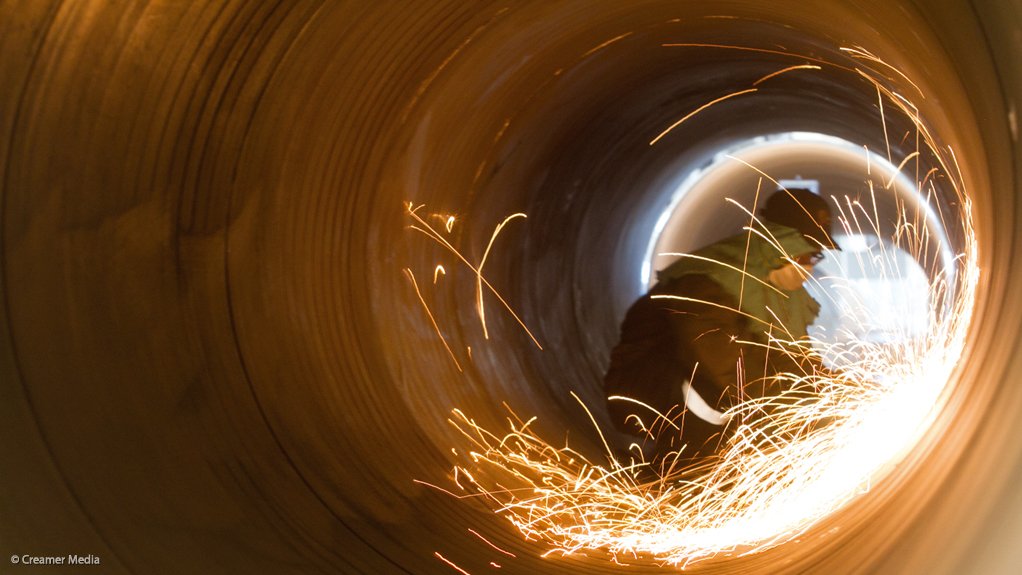



The South African steel industry – encompassing the full value chain, from upstream producers to downstream manufacturers and fabricators – has been described as being at a deindustrialisation ‘inflection point’.
The dire state of the sector, as well as the ineffectiveness of the prevailing interventions being pursued under the Steel Master Plan to arrest the sector’s decline, came into sharp focus during a Portfolio Committee on Trade, Industry and Competition meeting on Wednesday.
The meeting was addressed by various industry participants, who generally agreed that the prevailing crisis was the result of insufficient domestic demand and was being amplified by the weak enforcement of trade and strategic procurement measures designed to shore up the local industry.
There were, however, sharp disagreements over South Africa’s scrap policy, especially the way in which the price preference system (PPS) was being used to reduce the price of ferrous scrap to domestic steelmakers using electric-arc furnaces, with negative consequences for recyclers and integrated mills.
Steel and Engineering Industries Federation of South Africa CEO Tafadzwa Chibanguza argued that the perilous state of the industry was not a steel crisis alone, but an industrialisation crisis, arguing that the sector was at an inflection point.
He said the question facing South Africa was whether it could reverse deindustrialisation before critical industrial capabilities were permanently lost.
Chibanguza used four statistics to illustrate the unfolding “deindustrialisation story”: a fall in steel consumption per person to 67 kg from a previous peak of 92 kg; the slump in employment in the sector to 375 000 from 575 000 in 2008; the rise in steel imports to a yearly level of 1.58-million tonnes from 822 000 t; and the slump in manufacturing’s contribution to GDP to 12.8% from more than 16%.
“The strategic choice is one between an industrial economy that makes and builds things and exports value-added products, and an extractive economy that exports ore and imports finished products,” Chibanguza warned.
Hendok MD Freddie de Kock offered a real-world case study of the predicament facing domestic manufacturers, with the wire producer warning that jobs and local production were at serious risk after South Africa recently became a net importer of wire products.
“I recently evaluated what would happen if Hendok were to stop most of its local manufacturing and instead import certain key products. The result was clear: we could reduce our workforce by around 80%, from approximately 2 000 employees to 400 employees, and only continue manufacturing products that are either unique to us or where import logistics still create limitations. That is the reality facing South African manufacturers,” De Kock warned.
This import option was being made more attractive because of the ongoing circumvention of South Africa’s import tariffs by “fraudulent importers”, which were harming local industry and legitimate importers.
“If South Africa cannot ensure that all import duties are properly paid, then we need to have an honest discussion about whether steel duties should exist at all. That may sound extreme, but the current situation is also extreme. The higher the duties are, the more legitimate companies are penalised when others are allowed to avoid them. In that environment, duties no longer protect local manufacturing; they actually punish the companies that follow the rules,” De Kock argued.
STRUCTURAL DECLINE
South African Iron and Steel Institute secretary-general Charles Dednam provided an analysis showing that the steel industry was confronting a structural rather than a cyclical decline.
Crude steel production, he said, had fallen by 33% since 2018, long-steel import penetration had increased to 27%, while finished steel exports had collapsed by 63%.
“This is not a cyclical trough. Production is in secular decline, domestic finishing is being bypassed in favour of semi-finished exports and import penetration of both flat and long steel is structural,” Dednam said.
The contraction would continue, he argued, unless the sector secured electricity tariffs that were economically viable and leveraged public procurement policy to support local suppliers, including by enforcing verifiable local content requirements in the R1-trillion infrastructure programme.
He also argued that protection needed to be extended to downstream manufacturers, especially for fabricated steel products and embodied-steel categories, while making the case for incentivising value-added steel exports, especially under the African Continental Free Trade Area.
Chibanguza said the policy interventions could not substitute for demand and that the Steel Master Plan should, thus, not be judged on the number of meetings held or workstreams established.
Instead, he argued that it should be judged on whether South Africa was producing more, investing more, exporting more and employing more people.
“If South Africa wishes to industrialise, demand creation, competitiveness and implementation must now become priorities.”
SCRAP OVER SCRAP
Where there was no consensus, however, was on the government’s scrap policy and the effectiveness of the PPS.
While Scaw Metals MD Mark Jones said the PPS had been effective in reducing scrap exports, stimulating investment and reducing steel prices, the Recycling Association of South Africa (RASA) and the Metal Recycling Association called for its immediate suspension pending a review of its effectiveness.
RASA chairperson Geoff Borrajeiro argued that the current framework for regulating scrap metal exports was not achieving its stated policy objectives and was, instead, suppressing prices, weakening upstream feedstock supply and entrenching the dominance of a small number of local buyers.
Jones, however, argued that the continued imposition of export duties on ferrous scrap of 20% was important for the sustainability of the local steel industry and that, if local producers did not receive strong support from government, their cost competitiveness would be eroded.
South Africa’s largest steel producer, ArcelorMittal South Africa (AMSA), did not make a presentation and is currently trading under a cautionary announcement related to its ongoing talks with the State-owned Industrial Development Corporation.
The Department of Trade, Industry and Competition’s newly released Industrial Development Strategy includes a plan for finalising the takeover of AMSA, which recently mothballed its Newcastle mill, with the aim of restructuring and optimising its performance.
Article Enquiry
Email Article
Save Article
Feedback
To advertise email advertising@creamermedia.co.za or click here
Research Reports

Projects

Latest Multimedia

Latest News

Showroom
The Aluminium Federation of South Africa (AFSA), is the voice of the South African aluminium industry.
VISIT SHOWROOM
Goodwin Submersible Pumps Africa is sole distributors for Goodwin electrically driven, submersible, abrasion resistance slurry pumps.
VISIT SHOWROOM



Press Office
Announcements
What's On
Subscribe to improve your user experience...
Option 1 (equivalent of R125 a month):
Receive a weekly copy of Creamer Media's Engineering News & Mining Weekly magazine
(print copy for those in South Africa and e-magazine for those outside of South Africa)
Receive daily email newsletters
Access to full search results
Access archive of magazine back copies
Access to Projects in Progress
Access to ONE Research Report of your choice in PDF format
Option 2 (equivalent of R375 a month):
All benefits from Option 1
PLUS
Access to Creamer Media's Research Channel Africa for ALL Research Reports, in PDF format, on various industrial and mining sectors
including Electricity; Water; Energy Transition; Hydrogen; Roads, Rail and Ports; Coal; Gold; Platinum; Battery Metals; etc.
Already a subscriber?
Forgotten your password?
Receive weekly copy of Creamer Media's Engineering News & Mining Weekly magazine (print copy for those in South Africa and e-magazine for those outside of South Africa)
➕
Recieve daily email newsletters
➕
Access to full search results
➕
Access archive of magazine back copies
➕
Access to Projects in Progress
➕
Access to ONE Research Report of your choice in PDF format
RESEARCH CHANNEL AFRICA
R4500 (equivalent of R375 a month)
SUBSCRIBEAll benefits from Option 1
➕
Access to Creamer Media's Research Channel Africa for ALL Research Reports on various industrial and mining sectors, in PDF format, including on:
Electricity
➕
Water
➕
Energy Transition
➕
Hydrogen
➕
Roads, Rail and Ports
➕
Coal
➕
Gold
➕
Platinum
➕
Battery Metals
➕
etc.
Receive all benefits from Option 1 or Option 2 delivered to numerous people at your company
➕
Multiple User names and Passwords for simultaneous log-ins
➕
Intranet integration access to all in your organisation