BMW rolls out pilot studies on humanoid robot use in US, German plants; no deployment planned for SA

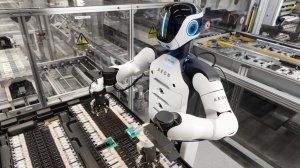


BMW is rolling out a pilot project to deploy humanoid robots at its Leipzig plant, in Germany.
This follows the completion of the first pilot deployment of humanoid robots at the BMW Spartanburg plant, in the US.
The German car maker says physical AI is a key element of advancing digitalisation and the use of AI in its production systems.
Physical AI combines digital AI with real machines and robots. This enables intelligent systems such as humanoid robots to be integrated into real-world production processes.
The Leipzig project aims to integrate humanoid robotics into the existing series production of cars, and to explore further applications in the production of batteries and components.
“Digitalisation improves the competitiveness of our production – here in Europe and worldwide,” says BMW management board member for production Milan Nedeljković.
“The symbiosis of engineering expertise and AI opens up entirely new possibilities in production.”
Last year, BMW successfully initiated a pilot project with humanoid robots at its Spartanburg plant.
The insights gained from this project are being leveraged to further develop and scale physical AI applications with the group.
“Our aim is to be a technology leader and to integrate new technologies into production at an early stage,” explains BMW production network, supply-chain management senior VP Michael Nikolaides.
“Pilot projects help us to test and further develop the use of physical AI – that is, AI-enabled robots capable of learning – under real-world industrial conditions.”
Humanoid robots are viewed as a value-add to existing automation.
According to BMW, they particularly demonstrate potential in monotonous, ergonomically demanding, or safety-critical tasks.
To aid the group in rolling out physical AI, BMW has set up a Centre of Competence for Physical AI in Production.
Here technology partners are evaluated according to well-defined maturity and industrialisation criteria, and tested in pilot projects under real-world production conditions.
Following a theoretical assessment, an evaluation is carried out at the manufacturer’s site in the laboratory using real use cases from the BMW production system to test integration capability.
If this phase is successful, it is followed by an initial test deployment under real-world production conditions at a BMW plant and, subsequently, an actual pilot phase.
The rollout of the humanoid project in Germany is happening in collaboration with Hexagon, a long-standing partner of BMW in the field of sensor technology and software.
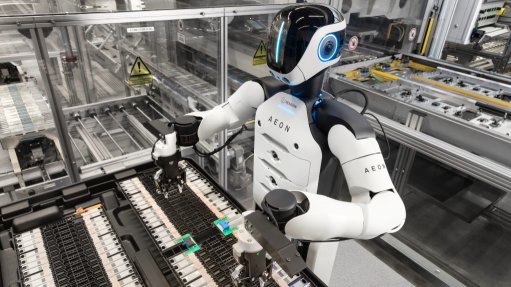
Hexagon Robotics specialises in physical AI and presented its first humanoid robot, AEON, in June last year.
The initial test deployment at the BMW plant Leipzig happened in December, followed by further test deployment from April onwards to ensure full integration.
The actual pilot phase is rolling out now, in the European summer.
The deployment in Leipzig is focused on testing a multifunctional application of the robot.
It is based on AEON’s design, with the human-like body allowing for a wide range of hand and grip elements, or for the attachment of scanning-tools, while it also enables the use of wheels to ensure floor movement.
During testing and later in the pilot phase, the robot will be used in the assembly of high-voltage batteries and in component manufacturing.
Success at Spartanburg
The Spartanburg study happened in collaboration with technology company Figure AI.
BMW says the results demonstrated that physical AI can deliver measurable added-value under real-world conditions.
Within ten months, the robot Figure 02 supported the production of more than 30 000 BMW X3 cars, working ten-hour shifts daily from Monday to Friday.
Figure 02 handled the precise removal and positioning of sheet metal parts for the welding process – a task that is particularly demanding in terms of speed and accuracy, while also being physically exhausting.
In total, it moved more than 90 000 components and covered roughly 1.2-million steps in around 1 250 operating hours.
The pilot study confirmed that humanoid robots can safely perform precise, repetitive work steps – such as positioning components with millimetre precision – and provided important insights for the further deployment of physical AI in production, reports BMW.
One key finding of the study was that the transition from the laboratory to the actual production environment was faster than expected, with motion sequences trained in the laboratory quickly transferred into stable shift operation.
The body shop was deliberately selected for the test phase at the Spartanburg plant, as it already has a high degree of automation.
For example, material supply on the line is already carried out almost exclusively via automated smart transport robots.
BMW and Figure are currently evaluating additional use cases for deploying a Figure 03 robot.
“The successful first deployment of humanoid robots at Spartanburg in the US proves that a humanoid robot can function not only under controlled laboratory conditions, but also in an existing automotive manufacturing environment,” notes Nikolaides.
What About the SA Plant?
BMW Group South Africa’s plant in Rosslyn, Pretoria, is fully integrated with the German manufacturer’s global production network.
The local facility, which produces the X3 for the local and export markets, will, however, not soon see the rollout of the humanoid robots.
A spokesperson for the local car maker says it is “very unlikely” that the humanoid robots would make their way to Rosslyn “in the foreseeable future”.
Competing With China
BMW’s rollout of humanoid robots comes amid the rapid rise of China’s auto industry, with many long-established vehicle manufacturers struggling to compete on a cost basis.
One of the areas where China is leading the pack is the automation of factories, so much so that a new term has been coined – dark factories, where there is no need to turn on the lights as there are hardly any humans present, with the robots able to work in the dark 24/7.
According to an April report by the International Federation of Robotics (IFR), China has two-million installed manufacturing robots (not humanoid).
This is approximately 4.5 times more than Japan, which is in second place.
China’s yearly installation numbers are impressive too, with 54% of all robots installed worldwide in 2024 deployed in China (295 000 units).
American factories installed 34 000 units.
China in May launched its 15th Five-Year Plan, in which it placed robotics at the heart of its modern industrial system.
The aim is to pivot its AI research towards physical applications, with robots as the main drivers for economic growth.
The IFR says economies worldwide are prioritising the integration of factory robots, as automation becomes a critical tool for boosting productivity.
When it comes to robot density, Western European countries reached a record 267 robots per 10 000 employees in the manufacturing industry in 2024, ahead of North America with 204 units, and Asia with 131 units.
Article Enquiry
Email Article
Save Article
Feedback
To advertise email advertising@creamermedia.co.za or click here
Research Reports

Projects

Latest Multimedia

Latest News

Showroom

Occupational health services, mobile clinics, wellness campaigns, aviation.
VISIT SHOWROOM
Rooted in the hearts of South Africans, combining technology and a quest for perfection to bring you a battery of peerless standing. Willard...
VISIT SHOWROOM


Press Office
Announcements
What's On
Subscribe to improve your user experience...
Option 1 (equivalent of R125 a month):
Receive a weekly copy of Creamer Media's Engineering News & Mining Weekly magazine
(print copy for those in South Africa and e-magazine for those outside of South Africa)
Receive daily email newsletters
Access to full search results
Access archive of magazine back copies
Access to Projects in Progress
Access to ONE Research Report of your choice in PDF format
Option 2 (equivalent of R375 a month):
All benefits from Option 1
PLUS
Access to Creamer Media's Research Channel Africa for ALL Research Reports, in PDF format, on various industrial and mining sectors
including Electricity; Water; Energy Transition; Hydrogen; Roads, Rail and Ports; Coal; Gold; Platinum; Battery Metals; etc.
Already a subscriber?
Forgotten your password?
Receive weekly copy of Creamer Media's Engineering News & Mining Weekly magazine (print copy for those in South Africa and e-magazine for those outside of South Africa)
➕
Recieve daily email newsletters
➕
Access to full search results
➕
Access archive of magazine back copies
➕
Access to Projects in Progress
➕
Access to ONE Research Report of your choice in PDF format
RESEARCH CHANNEL AFRICA
R4500 (equivalent of R375 a month)
SUBSCRIBEAll benefits from Option 1
➕
Access to Creamer Media's Research Channel Africa for ALL Research Reports on various industrial and mining sectors, in PDF format, including on:
Electricity
➕
Water
➕
Energy Transition
➕
Hydrogen
➕
Roads, Rail and Ports
➕
Coal
➕
Gold
➕
Platinum
➕
Battery Metals
➕
etc.
Receive all benefits from Option 1 or Option 2 delivered to numerous people at your company
➕
Multiple User names and Passwords for simultaneous log-ins
➕
Intranet integration access to all in your organisation