Inside Tharisa’s life-extending transition from openpit to underground mining

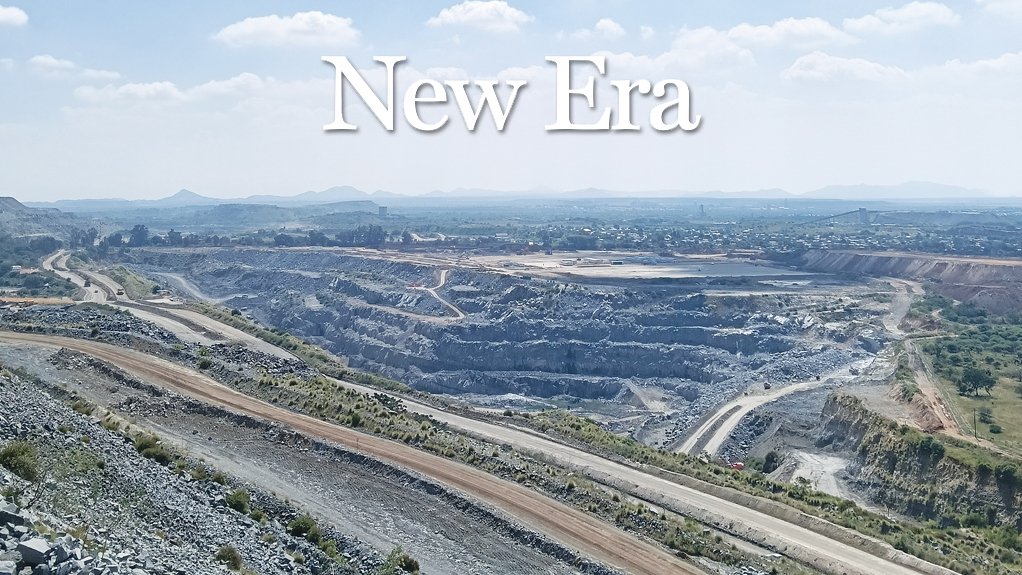


On March 31, 2026, just after 14:00, the detonation of 650 kg of explosives broke through the first rocks to enable access to underground resources at the Tharisa mine, located on the western limb of the Bushveld Complex, near Rustenburg, in the North West province.
Shortly after the inaugural underground blast, the company also detonated explosives in a section of its opencast operations, which are expected to remain active for another seven to nine years.
This milestone marked a new era for Tharisa Minerals as it advances its strategic transition from openpit to underground mining, unlocking at least 60 years of additional life for the platinum group metals (PGMs) and chrome mine.
Ahead of the expected depletion of the mine’s openpit resources by 2034, Tharisa has spent the past 18 months preparing the site by ensuring the high wall was safe and establishing the access points for the inaugural blast.
The underground development is a natural progression for Tharisa mine and forms a core pillar of the company’s long-term strategic vision and capital allocation. The hive of activity on site is expected to ensure sustained production while unlocking long-term value through a more efficient, flexible and lower-cost underground mining model covering multiple generations.
“It has been an exciting journey. We have been an openpit operator for more than 16 years now, and we have managed to extend the life of the openpit owing to the sheer economic value that we get out of coproduction of PGMs and chrome, which has proven its resilience throughout the commodity cycle,” Tharisa CEO Phoevos Pouroulis told Engineering News & Mining Weekly during a visit to the mine to witness the first blast.
Tharisa Minerals’ mining right was granted in September 2008 for an initial period of 30 years, covering more than 5 475 ha near Rustenburg and providing access to MG chromitite layers. The operations are supported by three production plants: Genesis, Vulcan and Voyager.
“It was always envisaged that we would transition to underground mining, and we are now at that point in time,” he added.
“It is a milestone event for us, as it signals the future of our operations. We have had this long life with the resource in the openpit, but by going underground now we unlock at least 60 years of mine life.”
The extension of the life-of-mine by several decades, ensuring the continued delivery of PGM and chrome concentrate into global markets, is aligned with a completed, board-approved definitive feasibility study (DFS) targeting an initial ten years of underground mining focused on the MG2 and MG4 chromitite layers at depths of about 450 m.
The group’s DFS indicates a declared resource of 60.7-million tonnes for the initial ten-year underground mining footprint, at an average of 19% chromium oxide (Cr2O3), classified as measured and indicated (1.71 g/t 6E PGMs). Declared reserves total 30.4-million tonnes at an average grade of 16.4% Cr2O3, classified as proved and probable (1.45 g/t 6E PGMs).
The DFS assumes a PGM basket price of $1 633/oz.
The company plans to invest more than $500-million over the next decade to sustain optimal output of more than 200 000 oz/y of PGMs and two-million tonnes of chrome concentrate.
“We are creating a long life and predictable growth. We are deploying the capital in a very sensitive way, spreading it over a period of time in a phased approach,” adds Tharisa Minerals MD Vulena Makuni.
“We have done quite a lot of drilling in terms of determining and making sure that the geology is safe and the risk is removed, such that we are able to ramp up to just over 250 000 t a month within 31 months to be able to achieve a steady state.”
The underground mine geometry is well suited to mechanised bord-and-pillar mining methods, supported by a fit-for-purpose fleet of trackless mining machinery, including load-haul dumpers, underground trucks, drill rigs, bolters, scissor lifts, shotcrete machines and graders, says underground mining contractor Cementation Africa.
Tharisa has previously highlighted how the shallow orebody enables more efficient on-reef mechanised development, delivering cleaner run-of-mine ore and significantly reducing waste, capital intensity and environmental impact.
With minimal off-reef mining required, a smaller fleet and on-reef development, underground mining offers a lower carbon footprint, while leveraging established infrastructure.
As key development partner for the underground project, Cementation Africa will, over the next five years, be responsible for the early works, the main development programme, and the production ramp-up, says Cementation Africa MD Japie du Plessis.
Following the first blast, Tharisa announced on May 7 the official signing of the five-year contract with Cementation Africa for the execution of the underground mining development and construction works, structured on an alliance contracting model that aligns the interests of both parties and is underpinned by an open-book, cost-plus-fee approach and aligned principles, rather than a traditional rates-based, risk-transfer model.
Developing Underground Operations
The underground progression, expected to cost $547-million, comprises two decline developments – Apollo on the west side and Orion on the east – that will eventually meet to deliver an aggregate 510 000 t/m.
Tharisa has started with the Apollo portal access on the west side of the openpit operation, ramping up over the next three years to a steady-state rate of 255 000 t a month. The Apollo portal development carries a capital cost of $363-million.
“As we achieve that steady state, we will start with the Orion east-side portal development, where we will then join the two workings of the underground,” Pouroulis explains, adding that the transition to fully underground operations will be completed by 2034.
The Orion portal development, which will require $184-million, is scheduled to start in 2031, with first ore targeted for the fourth quarter of that year and steady-state production by the third quarter of 2033.
The east and west operations will mirror each other, producing 255 000 t each, equating to more than 6.2-million tonnes a year. This provides the mine with some headroom in terms of its processing nameplate capacity of 5.6-million tonnes and opening the optionality of increasing its processing capacity.
“We can scale it up or down, depending on what we require,” says Tharisa Minerals operations executive Roy Murley.
With the west pit expected to provide about another two years of mining, the company will jointly develop the underground resource while depleting the remaining opencast reserves in the west pit.
Murley notes that the surface infrastructure for the underground workings will be completed within the next few months, including the main access, parking facilities, the administration area, a change house and related infrastructure.
“It is an ecosystem that has come together very nicely where we can continue to contribute to our communities, to the broader economy, and provide that sustainable employment that our country desperately needs,” Pouroulis says.
The commitment to transition underground over the next ten years provides certainty around employment, job opportunities and skills transfer.
Through Cementation Africa, plans are under way to upskill and transition the mine’s current operators from openpit to underground.
Du Plessis notes that Cementation Africa’s role extends beyond mine development and excavation to include establishing the systems, governance structures and safety frameworks required for underground operations.
The project also includes significant skills development and workforce mobilisation. Through its Training Academy near Carletonville, Cementation Africa will support the reskilling of personnel as the operation transitions from openpit to mechanised underground mining.
He adds that innovation and collaboration with original-equipment manufacturer partners will also form part of the project’s long-term success, including the adaptation of proven technologies to improve ore handling and operational efficiency.
Pouroulis says that the fully equipped smart mine, supported through a technical partnership with Dwyka Labs, was established with the ability to leverage new technologies as they emerge.
The group partnered with Dwyka to unlock future opportunities to test emerging technologies in a live operating mine environment.
“It is the new opportunities that we want to pioneer here at Tharisa. We are at that privileged point in time where we can select and choose tried and tested technologies in some pioneering optionality.”
He cites the example of a robot dog called Spot, which will enter an area after blasting to remotely examine it to ensure it is safe before human entry.
“Our vision is to redefine resources, to challenge convention, to do things differently, but on a sustainable basis, to innovate with purpose, to empower futures,” he continues.
“It is just the beginning of a multigenerational journey,” Pouroulis says.
“We have the passion, we have the people, we have the skills, and importantly, we have the vision. This is a model that can be replicated, and motivates new entrants into the mining industry to do the same, because it certainly has that massive multiplier effect.”
Article Enquiry
Email Article
Save Article
Feedback
To advertise email advertising@creamermedia.co.za or click here
Research Reports

Projects

Latest Multimedia
Latest News

Showroom
Established in 1983, the ASTPM is an industry association and representative body of the welded carbon steel tube and pipe manufacturers of South...
VISIT SHOWROOM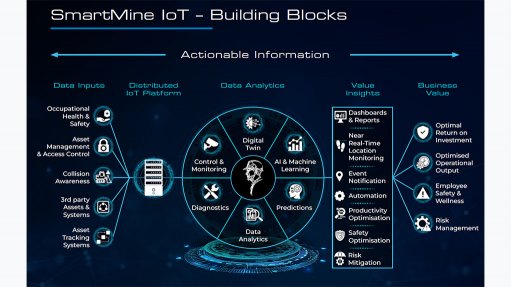
SmartMine IoT has been developed with the mining industry in mind, to provides our customers with powerful business intelligence and data modelling...
VISIT SHOWROOM

Press Office
Announcements
What's On
Subscribe to improve your user experience...
Option 1 (equivalent of R125 a month):
Receive a weekly copy of Creamer Media's Engineering News & Mining Weekly magazine
(print copy for those in South Africa and e-magazine for those outside of South Africa)
Receive daily email newsletters
Access to full search results
Access archive of magazine back copies
Access to Projects in Progress
Access to ONE Research Report of your choice in PDF format
Option 2 (equivalent of R375 a month):
All benefits from Option 1
PLUS
Access to Creamer Media's Research Channel Africa for ALL Research Reports, in PDF format, on various industrial and mining sectors
including Electricity; Water; Energy Transition; Hydrogen; Roads, Rail and Ports; Coal; Gold; Platinum; Battery Metals; etc.
Already a subscriber?
Forgotten your password?
Receive weekly copy of Creamer Media's Engineering News & Mining Weekly magazine (print copy for those in South Africa and e-magazine for those outside of South Africa)
➕
Recieve daily email newsletters
➕
Access to full search results
➕
Access archive of magazine back copies
➕
Access to Projects in Progress
➕
Access to ONE Research Report of your choice in PDF format
RESEARCH CHANNEL AFRICA
R4500 (equivalent of R375 a month)
SUBSCRIBEAll benefits from Option 1
➕
Access to Creamer Media's Research Channel Africa for ALL Research Reports on various industrial and mining sectors, in PDF format, including on:
Electricity
➕
Water
➕
Energy Transition
➕
Hydrogen
➕
Roads, Rail and Ports
➕
Coal
➕
Gold
➕
Platinum
➕
Battery Metals
➕
etc.
Receive all benefits from Option 1 or Option 2 delivered to numerous people at your company
➕
Multiple User names and Passwords for simultaneous log-ins
➕
Intranet integration access to all in your organisation