Big container recovery required if South Africa is to meet 250Mt rail target

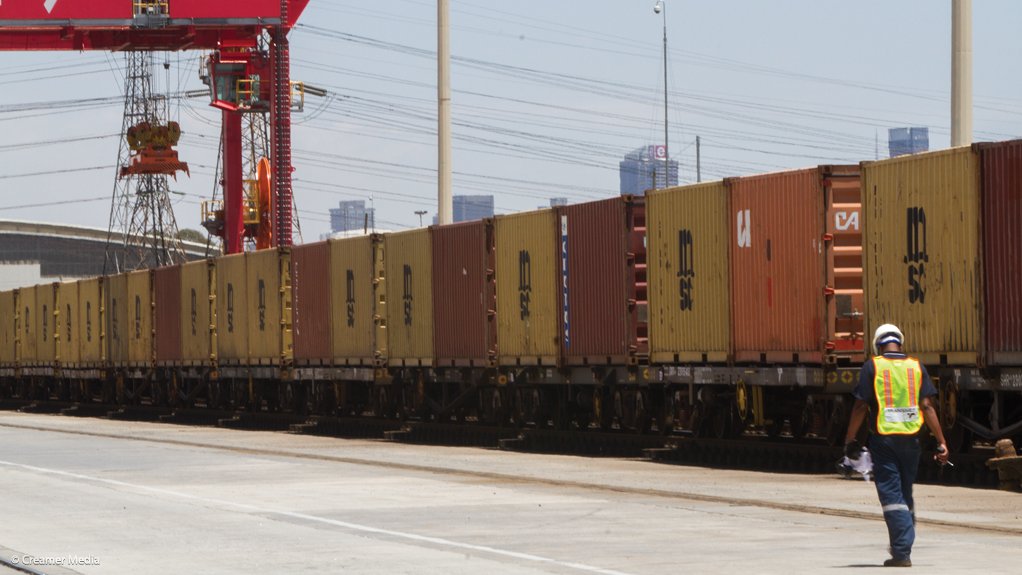


Meeting the South African government’s target of moving 250-million tons of freight yearly on rail by 2030 will be achieved only if there is a significant recovery in general freight volumes, which in turn requires a large rise in container volumes, a leading macrologistician argues.
GAIN Group director Professor Jan Havenga calculates that to close the gap between the volumes currently being achieved of about 160-million tons and the target that has been set will require “nearly half” of those volumes being met through containers.
The recent recovery in volumes, he points out, has been led largely by an increase in volumes on the bulk coal and iron-ore corridors, with the recovery in general freight having been underpinned by a strong rise in manganese.
Once manganese is stripped out from the figures, general freight volumes on rail have actually fallen, Havenga highlights.
“To get to 250-million tons, it must come from the general freight business and increasingly in the form of container freight,” he explains, with the bulk corridors expected to contribute 145-million tons and general freight 105-million tons to the target.
However, while the commodity corridors are closing in on matching their 145-million-ton yearly contribution, the general freight business is nowhere near meeting its 105-million tons contribution, having delivered less than 40-million tons last year.
“If you look 30 years into the future, the railways will be a container railway by 2055, or it will not be,” Havenga avers, an argument premised on a demand model that the GAIN Group has been running for 20 years, and which enables it to model future freight demand patterns.
In addition, a failure to secure rail-friendly general freight has resulted in congested road corridors, and is contributing to inefficiencies that are costing the South African economy an estimated R450-million daily.
The upshot is that national logistics costs as a percentage of GDP are already too high at about 11.6% and are far worse when logistics costs are measured as a percentage of transportable GDP at nearly 54%.
Havenga estimates that some 100-million tons of freight that should be on rail – including mined commodities used domestically and destined for export markets, as well as intermediate and finished manufactured goods – is currently “missing” from the rail system.
In addition, the value of the cargo carried in containers far exceeds that which moves on the bulk corridors.
Describing South Africa as a “spatially challenged” country, where the landmass is large relative to the size of the economy, creating higher demand for transport services, Havenga argues that three integrated actions are needed to address the high cost of freight logistics, namely:
- A rebuilding of the rail network to support not only import-export corridors, but also domestic general-freight corridors linked to consolidation hubs;
- Greater collaboration across the transport ecosystem, with a keener focus on container planning; and
- Coordinated spatial planning for freight villages.
“The network should have between 20 and 30 nodes serving major production and consumption areas,” he argues.
Similar models have been implemented in countries such as Uzbekistan and India and Havenga argues that, in the South African context, it could yield cost savings of R100-billion in more efficient long-haul and last-mile logistics.
In addition, it could sustain South Africa’s regional logistics relevance, notwithstanding the ongoing shift away from the north-south corridor to ones that are increasingly connecting the interior to ports on the east and west coasts.
“The biggest gap currently is in general freight rail and there is still no clear plan to recover it despite the good efforts of the National Logistics Crisis Committee.
“If government wants to meet its 250-million-ton target it has to recognise that nearly half of what is missing will be in containers, or the target simply will not be met,” Havenga asserts.
Transport Minister Barbara Creecy has also highlighted the vital role of containers in raising rail freight volumes and she recently secured Cabinet approval to release a draft National Rail Master Plan for public comment.
The document seeks to translates the National Rail Policy, approved by Cabinet in 2022, into a practical, phased investment and implementation plan for freight and passenger rail over the coming decades.
In addition, the new industry organisation known as the Container User Forum was formally launched earlier this year to facilitate greater collaboration among South Africa’s container stakeholders, as well as to provide a unified voice for the sector.
Article Enquiry
Email Article
Save Article
Feedback
To advertise email advertising@creamermedia.co.za or click here
Research Reports

Projects


Latest Multimedia

Latest News

Showroom

Complete range of security sealing solutions including security seals bags and labels.
VISIT SHOWROOM



Press Office
Announcements
What's On
Subscribe to improve your user experience...
Option 1 (equivalent of R125 a month):
Receive a weekly copy of Creamer Media's Engineering News & Mining Weekly magazine
(print copy for those in South Africa and e-magazine for those outside of South Africa)
Receive daily email newsletters
Access to full search results
Access archive of magazine back copies
Access to Projects in Progress
Access to ONE Research Report of your choice in PDF format
Option 2 (equivalent of R375 a month):
All benefits from Option 1
PLUS
Access to Creamer Media's Research Channel Africa for ALL Research Reports, in PDF format, on various industrial and mining sectors
including Electricity; Water; Energy Transition; Hydrogen; Roads, Rail and Ports; Coal; Gold; Platinum; Battery Metals; etc.
Already a subscriber?
Forgotten your password?
Receive weekly copy of Creamer Media's Engineering News & Mining Weekly magazine (print copy for those in South Africa and e-magazine for those outside of South Africa)
➕
Recieve daily email newsletters
➕
Access to full search results
➕
Access archive of magazine back copies
➕
Access to Projects in Progress
➕
Access to ONE Research Report of your choice in PDF format
RESEARCH CHANNEL AFRICA
R4500 (equivalent of R375 a month)
SUBSCRIBEAll benefits from Option 1
➕
Access to Creamer Media's Research Channel Africa for ALL Research Reports on various industrial and mining sectors, in PDF format, including on:
Electricity
➕
Water
➕
Energy Transition
➕
Hydrogen
➕
Roads, Rail and Ports
➕
Coal
➕
Gold
➕
Platinum
➕
Battery Metals
➕
etc.
Receive all benefits from Option 1 or Option 2 delivered to numerous people at your company
➕
Multiple User names and Passwords for simultaneous log-ins
➕
Intranet integration access to all in your organisation