Mammoth regional tailings dam is centrepiece of DRDGOLD’s R10bn expansion

DRDGOLD R10-billion expansion presentation covered by Mining Weekly's Martin Creamer. Video: Darlene Creamer
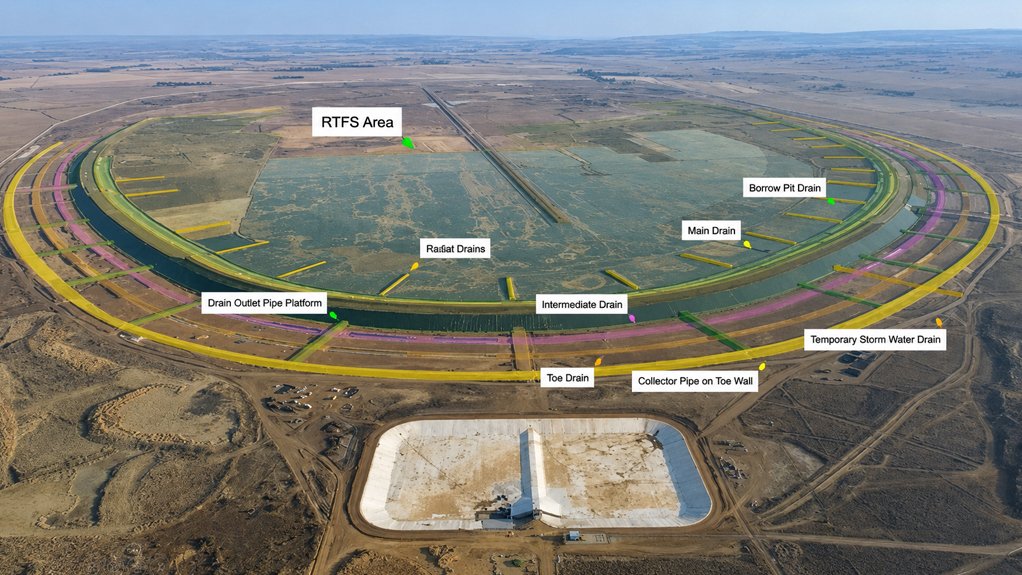
Comprehensive drainage of tailings storage facility.
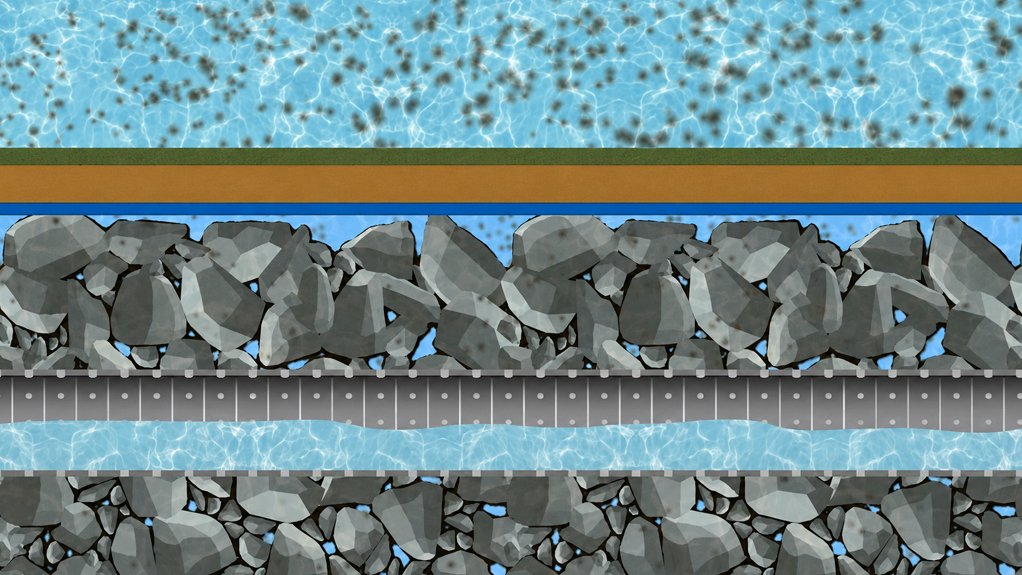
Cross section of the layering of the tailings facility.



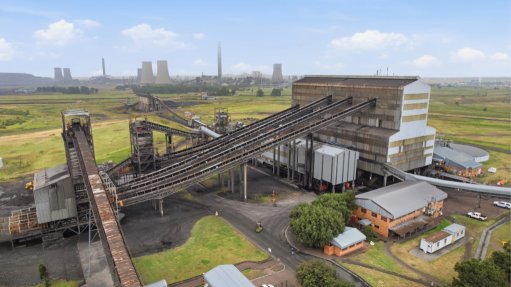
JOHANNESBURG (miningweekly.com) – The centrepiece of the R10-billion five-project Vision 2028 of DRDGOLD is the mammoth regional tailings storage facility (RTSF) at Far West Gold Recoveries surface retreatment operation, near Carletonville, in South Africa’s Gauteng province.
The commissioning of the fully lined RTSF, which covers an area of 800 ha, is being sequenced through defined regulatory, construction and seasonal gates.
Targeted in the first quarter of financial year (FY) 2028 is stable production of 1.2-million tonnes a month with an opportunity to double that to 2.4-million tonnes a month.
Once developed, RTSF, which is 67% complete, will accommodate up to 800-million tonnes of tailings and support the long-term production profile of Far West Gold Recoveries for many decades to come.
Highlighted on the final slide of a 27-slide RTSF construction-focused presentation by DRDGOLD COO Jaco Schoeman was a near-term opportunity to recover 120 kg of gold by increasing the treatment capacity at Driefontein Two (DP2), also a Vision 2028 project. (Also watch attached Creamer Media video.)
“We have an opportunity to increase the treatment capacity at DP2 from 500 000 t a month to 600 000 t a month, up to a point in time when we then anticipate bringing the Libanon tailings dam online. As soon as Libanon tailings dam is brought online, we can increase the treatment capacity from 600 000 t up to 1.2-million tons per plant.
“So, during this period, there's an opportunity to increase it from 500 000 t a month to 600 000 t a month for a six-month period, which equates to 120 kilograms of gold. But this is dependent on getting regulatory approval, getting the Libanon facility up and running, and making sure that the construction is happening on time.
“It is also weather dependent. Additional rain poses a risk for this facility. Therefore, the current planning for us is to continuously look at this opportunity and see how the construction of this facility is proceeding.
“But eventually, after quarter four of 2027, we intend to then ramp up to 1.2-million tonnes a month, and this is to ensure that we do not compromise the RTSF facility, making sure that it's constructed in a responsible manner,” Schoeman stated in the presentation in which DRDGOLD CEO Niël Pretorius and DRDGOLD CFO Henriette Hooijer also participated.
All the water from the R3.4-billion RTSF ends up in reclamation stations, for use in a closed water circuit.
The first phase of the three-phase project is to get authorisation to begin deposition while still constructing the rest of the dam during Phase 2 and Phase 3.
For the first phase, the RTSF requires what is termed beneficial occupation, that is, authorisation to start depositing on part of the tailings facility, while still constructing the rest of the dam as part of Phase 2 and Phase 3.
Displayed was the large area that needs to be lined, parts already lined and areas associated with considerable drainage. Ahead of receiving beneficial occupation, water that falls on RTSF’s lower southern area needs to be drained.
The topography slopes from north to south and a temporary stormwater drain canal is being installed in the south.
At this point in time, all water drains through that stormwater canal, but once beneficial occupation authorisation is obtained, the stormwater canal must be sealed off.
Drainage comes in the form of radial drains, which extend into the basin of the RTSF, the borrow pit drain that extends around the tailings dam on the inside of the starter wall, the main drain that recovers water from the inside of the basin and the floor of the tailings dam, an intermediate drain and a toe drain.
Once depositing commences, deposition will be on inside drainage, which is called upstreaming and at a point in time, downstream depositing will also commence. That will take place on the outside of the dam, where the intermediate drain comes into play.
At the toe of the tailings facility is another set of drains and the water from all of these drains is directed into a collector pipe that feeds dams three and four on the RTSF’s southern side.
The purpose of the drains is to collect water from the base of the facility and because of its lining, the only way for the water to exit the facility is through the drainage system.
“So, the drains are extremely important design factor,” Schoeman emphasised during the Vision 2028 update presentation covered by Mining Weekly.
Inside the facility will be a berm wall on which a decant pumping system will be positioned, which will be retracted once the filling of the tailings dam begins. This water, which is captured higher up in the facility and is on top of the tailings dam, is drained and pumped to water dams one and two at the top of the facility.
From the bottom of the facility, water is sent to dams three and four in the south, whence it is also pumped through an external pipeline to dams one and two in the north.
“So, all of the water from this facility eventually ends up in dams one and two, and then it's pumped from dams one and two to the reclamation stations, where we utilise all of the water in a closed water circuit,” Schoeman pointed out.
Rain is probably the biggest potential negative impact on the construction of the facility, and displayed was a high-risk zone if there is a rain during the construction phase.
A temporary stormwater drainpipe is currently in position to drain clean water off site ahead of it being polluted by mining activity.
“Once we start with beneficial occupation and depositioning, we've got to close up this temporary stormwater pipe. We actually seal it up with concrete, and all of the water is then contained that falls on the surface area,” Schoeman pointed out.
As material is deposited into this bottom part of the basin, good drainage is essential because stormwater entering into the area reduces the density of the material.
As soon as the density of the material is reduced, there is a risk of getting segregation of finer particles, which lowers the effectiveness of the drainage system.
To minimise segregation, the starter wall and the borrow pit section are compacted, rolled and prepared for the liner laying and drainage system installation.
Displayed was the base layer of the earthworks being constructed to ensure competence prior to the drainage system being placed. All the drainpipes are connected to the collector pipe manhole and displayed was the entry of the radial, main and intermediate drains feeding into the manhole and the collector pipeline surrounding the tailings dam.
Once the surface area has been prepared, high-density polyethylene (HDPE) liner is placed over it to prevent groundwater entry and to capture any facility water.
Then the HDPE liner itself is protected by the placing of a geomembrane on top of it.
The next layer placed is a stone base layer and then on top of that a perforated pipe, which is the main water remover. The perforated pipeline is covered with additional stone material and once that is levelled out, a geofabric is folded over the constructed material. Thereafter, a sacrificial liner is placed on top to ensure that any dust blown over the area does not contaminate the sand layer. Once depositing begins, the sacrificial liner will be removed.
A side view of the various constructed layers of sand, geomembrane, stone and perforated pipe emphasised their purpose, with water shown as flowing through the various layers, entering the perforated pipeline and being removed from the base of the facility.
“The problem, however, is if we drop the density and we get segregation, then the fine particles in the material flow faster than the heavier material, and that then starts flowing into the material on top of the perforated pipe.
“It enters in there and then starts clogging up the sand as well as the spaces in between the stone material. If you allow that for long enough, you run the risk of clogging up this entire circuit and preventing water from entering into the drainage system.
This is very important to us. This is the only way we've got to remove the water from the base of the facility,” said Schoeman in emphasising the importance of preventing segregation from taking place.
The RTSF is viewed as being an enabler of further growth and a regional consolidation provider.
Capital allocated to FY2029 under Vision 2028 includes:
- R3.4-billion for RTSF;
- R1.9-billion for DP2, where R880-million has also been approved for DRDGOLD’s first-ever use of an up-flow reactor;
- R1.2-billion for 135 km of pipeline network to serve DP2, RTSF and the Libanon TSF in Westonaria;
- R0.5-billion for the Daggafontein TSF at Ergo on the East Rand; and
- R3-billion for the Withok TSF also on the East Rand.
Article Enquiry
Email Article
Save Article
Feedback
To advertise email advertising@creamermedia.co.za or click here
Research Reports
Projects


Latest Multimedia

Latest News

Showroom

ESAB South Arica, the leading supplier of high-end welding and cutting products to the Southern African industrial market is based in...
VISIT SHOWROOM
Developed to exceed the latest EN 15964 standards for police breathalysers proving that it will remain accurate and reliable for many years to come.
VISIT SHOWROOM



Announcements
What's On
Subscribe to improve your user experience...
Option 1 (equivalent of R125 a month):
Receive a weekly copy of Creamer Media's Engineering News & Mining Weekly magazine
(print copy for those in South Africa and e-magazine for those outside of South Africa)
Receive daily email newsletters
Access to full search results
Access archive of magazine back copies
Access to Projects in Progress
Access to ONE Research Report of your choice in PDF format
Option 2 (equivalent of R375 a month):
All benefits from Option 1
PLUS
Access to Creamer Media's Research Channel Africa for ALL Research Reports, in PDF format, on various industrial and mining sectors
including Electricity; Water; Energy Transition; Hydrogen; Roads, Rail and Ports; Coal; Gold; Platinum; Battery Metals; etc.
Already a subscriber?
Forgotten your password?
Receive weekly copy of Creamer Media's Engineering News & Mining Weekly magazine (print copy for those in South Africa and e-magazine for those outside of South Africa)
➕
Recieve daily email newsletters
➕
Access to full search results
➕
Access archive of magazine back copies
➕
Access to Projects in Progress
➕
Access to ONE Research Report of your choice in PDF format
RESEARCH CHANNEL AFRICA
R4500 (equivalent of R375 a month)
SUBSCRIBEAll benefits from Option 1
➕
Access to Creamer Media's Research Channel Africa for ALL Research Reports on various industrial and mining sectors, in PDF format, including on:
Electricity
➕
Water
➕
Energy Transition
➕
Hydrogen
➕
Roads, Rail and Ports
➕
Coal
➕
Gold
➕
Platinum
➕
Battery Metals
➕
etc.
Receive all benefits from Option 1 or Option 2 delivered to numerous people at your company
➕
Multiple User names and Passwords for simultaneous log-ins
➕
Intranet integration access to all in your organisation