Afrimat posts solid results; sets focus on growing cash generation, reducing debt



Although it remains profitable, is able to service its debt and posted good results for the financial year ended February 28, JSE-listed construction materials and industrial minerals mining company Afrimat is focused on increasing its cash generation and reducing its debt.
The company posted a net profit of R157.07-million for the financial year under review, compared with a net profit of R113.51-million reported for the 2025 financial year. Headline earnings increased to R145.72-million, from R109.69-million in the prior year.
Revenue increased by 20.3% year-on-year to R10-billion and operating profit by 9.6% year-on-year to R523.7-million.
Earnings a share increased by 27% to 80c and headline earnings a share by 32.5% to 95.8c. Net asset value increased slightly to R28.99 a share, up from R28.62 a share in the prior financial year.
Cash generated from operations increased to R831.4-million, up from R571.6-million in the prior financial year.
During the financial year under review, the company worked to place cash generation on a firmer footing for the future. This and cash from the sale of noncore assets and properties expected in the current financial year, will be used to pay down debt, the company says.
Cash flow from operating activities is beginning to recover. A stock build-up in the Iron Ore business, owing to a domestic customer unexpectedly taking less volume, temporarily tied up cash, but Afrimat has implemented initiatives to convert these stockpiles into cash.
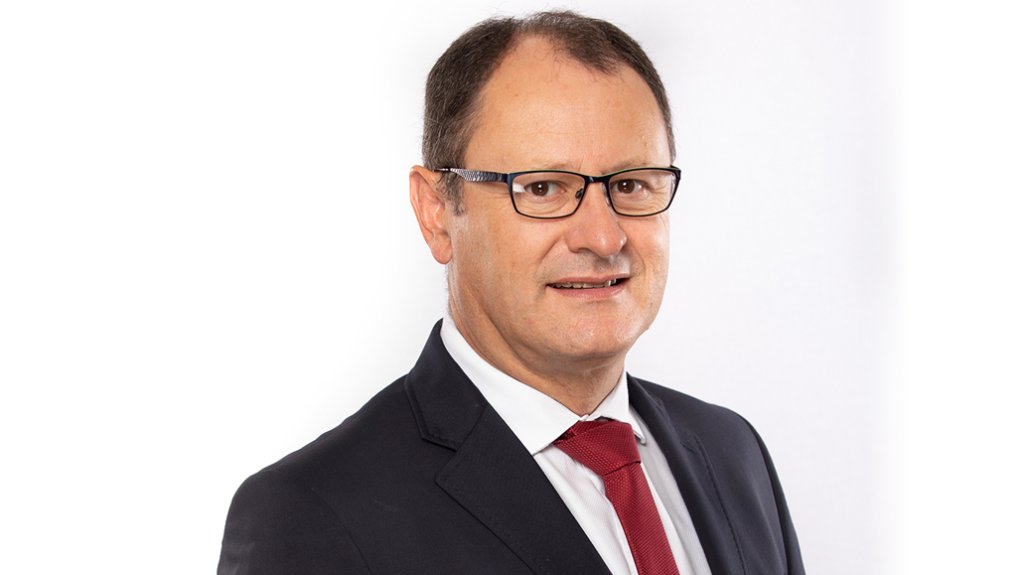
“The financial focus going forward will be to assist businesses in driving cash generation and use that cash to reduce debt,” says Afrimat Group CEO Andries van Heerden.
The group’s net debt was R2.24-billion as at February 28.
Chairperson Francois Louw notes in the company’s ‘Integrated Annual Report 2026’, that it plans to reduce debt to equity from the current 50.2% to about 25% over the next two years.
“The team feels that although Afrimat can service debt, we want to reduce these levels quickly to create capacity should an additional commodity opportunity arise,” Van Heerden states in the report.
Meanwhile, Van Heerden says the group completed and integrated significant strategic acquisitions.
“Our renewed focus on aggregate quarrying has proved to be well-timed and the Lafarge integration is complete and performing exceptionally well.
“The aggregates business has been significantly strengthened and is performing well. Our core strength remains opencast mining and, for the cement and the Glenover projects, we are actively assessing a range of strategic alternatives and potential technology partners,” he says.
Further, Afrimat acquired the Glenover rare earths and phosphate mine in 2021 to gain exposure to critical minerals. The resource contains a unique combination of minerals, including phosphate, iron and a high concentration of valuable rare earth minerals.
Comprehensive research and development have demonstrated that the Glenover material is a highly valuable feedstock for modern batteries and a source of rare-earth minerals.
“Discussions to identify suitable technical partners to advance the project towards implementation are progressing well. Afrimat has prioritised project strength over speed and has invested the time needed to position the project as globally competitive,” Van Heerden says.
As the world prepares for AI and hyperscale data centres, demand for rare-earth elements is rising, and Afrimat recognises Glenover’s significance in this scenario.
While the group is experienced in mining this type of asset, it has started discussions with reputable international and local technical and financial companies to partner with it on this project to develop processing technology for extracting battery minerals and rare earths, he says.
SEGMENT RESULTS
Revenue from Afrimat’s construction materials segment increased by 20.7% year-on-year to R5.4-billion, with revenue from the aggregates business having increased by 11.2% and revenue from the cement business by 54.3%.
The aggregates business’s operating profit increased by 24%, with its operating profit margin increasing to 17.7%, up from 15.8% in the prior financial year. The overall business segment's margin improved slightly to 9.3%, owing to the negative contribution from the cement business.
Significant progress was made in the aggregates business during the second half of the financial year, which positioned it as a stronger, more competitive player, including maintenance, repairs and operational improvements to the quarries acquired as part of the Lafarge acquisition.
The cement business contributed R1.56-billion in revenue, up 54.3% year-on-year, but posted an operating loss of R185.1-million. Cement sales volumes increased by 36.2% and clinker production increased by 18.8% year-on-year.
Afrimat spent R271.6-million during the year under review on substantial remedial work and maintenance. This has stemmed losses in the cement business and, with its performance sufficiently improved, various strategic alternatives are being considered.
Quarries that are delivering suboptimal margins are part of initiatives to bring their performance in line with the overall aggregates margin.
Further, revenue growth in the construction materials segment was driven by a wider presence across the country and continued orders from road, construction and rail projects as well as some provincial infrastructure maintenance.
The group's noncore brick and block and readymix businesses, and noncore properties, were sold during the year under review.
Meanwhile, Afrimat’s bulk commodities business segment increased its revenue by 15.7% year-on-year.
Its iron-ore mines’ operating profit increased by 35.3% to R605.1-million, up from R447.1-million in the prior financial year. The first half of the year delivered strong volume performance from local iron-ore sales, which was partially offset by a softer trading environment in the second half.
Afrimat achieved year-on-year volume growth and increased local sales volumes to 1.51-million tons, up from 876 215 t in the prior year. The decline in volumes towards year-end weighed on profitability.
Further, international iron-ore sales were adversely impacted on by lower dollar prices, which declined by 2.9%; a decrease in the lump premium of 8.3%; and concurrent strengthening of the rand by 4.5%.
Exports continue to be impacted by the limitations on the rail system and international sales tonnage decreased marginally from 726 436 t in the 2025 financial year to 721 947 t in the year under review.
Afrimat has applied for an increased allocation on the iron-ore export line from its current allocation of 870 000 t/y and expects a final decision from State-owned rail operator Transnet towards the end of 2027.
Additionally, in the bulk commodities segment, Afrimat's anthracite mine’s revenue increased by 0.6% to R833.7-million.
Anthracite from stockpiles was sold in the international market, with export volumes increasing substantially to 206 271 t from 74 244 t in the prior year. However, pricing was low and the increase was insufficient to offset the loss in local volumes.
Total anthracite volumes for the 2026 financial year were 1.8% lower at 345 189 t.
The temporary shutdown of all South African ferrochrome smelters in August 2025 had a significant impact on Nkomati’s revenue. No domestic sales took place for the second half of the financial year, and operations were suspended as part of cost-containment measures, Afrimat says.
This shutdown, together with an impairment of the underground operation amounting to R118.2-million, resulted in an operating loss of R160.5-million, compared with an operating profit of R57.3-million in the prior financial year.
Local volume sales declined to 138 918 t, down from 277 151 t in the financial year to end February 2025.
Afrimat notes that a reduced electricity tariff for the ferrochrome industry could drastically improve Nkomati’s prospects.
Two of the country’s ferrochrome producers and power utility Eskom have agreed to a 62c/kWh tariff, but this remains subject to approval by the National Energy Regulator of South Africa, which is due to make an announcement on this in June.
Article Enquiry
Email Article
Save Article
Feedback
To advertise email advertising@creamermedia.co.za or click here
Research Reports
Projects

Latest Multimedia
Latest News

Showroom
North Ridge Pumps is an independent manufacturer of pumps. We have a proven track record for product support and customer service throughout the...
VISIT SHOWROOM
Announcements
What's On
Subscribe to improve your user experience...
Option 1 (equivalent of R125 a month):
Receive a weekly copy of Creamer Media's Engineering News & Mining Weekly magazine
(print copy for those in South Africa and e-magazine for those outside of South Africa)
Receive daily email newsletters
Access to full search results
Access archive of magazine back copies
Access to Projects in Progress
Access to ONE Research Report of your choice in PDF format
Option 2 (equivalent of R375 a month):
All benefits from Option 1
PLUS
Access to Creamer Media's Research Channel Africa for ALL Research Reports, in PDF format, on various industrial and mining sectors
including Electricity; Water; Energy Transition; Hydrogen; Roads, Rail and Ports; Coal; Gold; Platinum; Battery Metals; etc.
Already a subscriber?
Forgotten your password?
Receive weekly copy of Creamer Media's Engineering News & Mining Weekly magazine (print copy for those in South Africa and e-magazine for those outside of South Africa)
➕
Recieve daily email newsletters
➕
Access to full search results
➕
Access archive of magazine back copies
➕
Access to Projects in Progress
➕
Access to ONE Research Report of your choice in PDF format
RESEARCH CHANNEL AFRICA
R4500 (equivalent of R375 a month)
SUBSCRIBEAll benefits from Option 1
➕
Access to Creamer Media's Research Channel Africa for ALL Research Reports on various industrial and mining sectors, in PDF format, including on:
Electricity
➕
Water
➕
Energy Transition
➕
Hydrogen
➕
Roads, Rail and Ports
➕
Coal
➕
Gold
➕
Platinum
➕
Battery Metals
➕
etc.
Receive all benefits from Option 1 or Option 2 delivered to numerous people at your company
➕
Multiple User names and Passwords for simultaneous log-ins
➕
Intranet integration access to all in your organisation