Engineered demolition ends in environmental stability

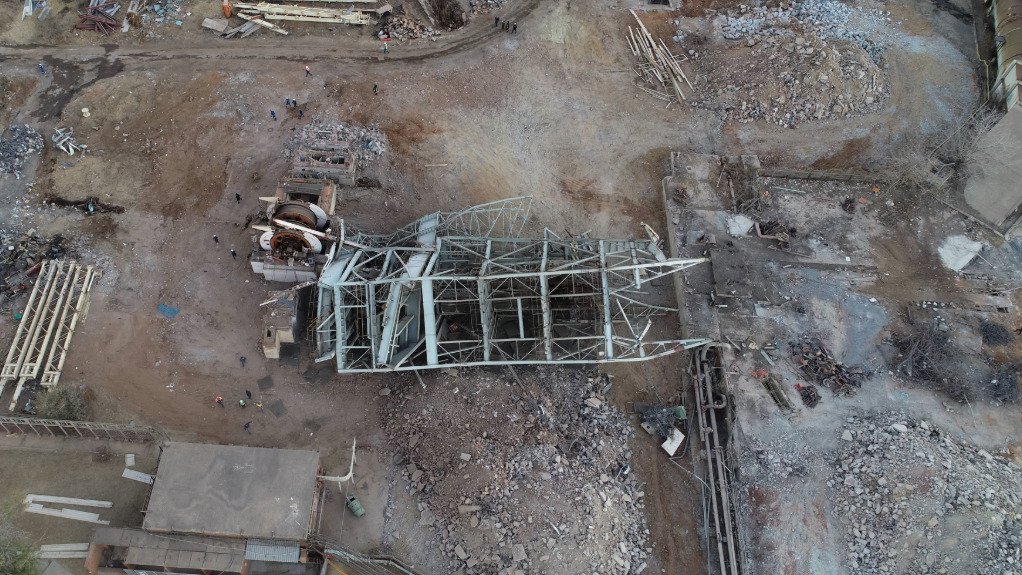
FELLING A GIANT The 46-m-high Beatrix 2 shaft headgear of Sibanye-Stillwater was successfully downed by Draco Group
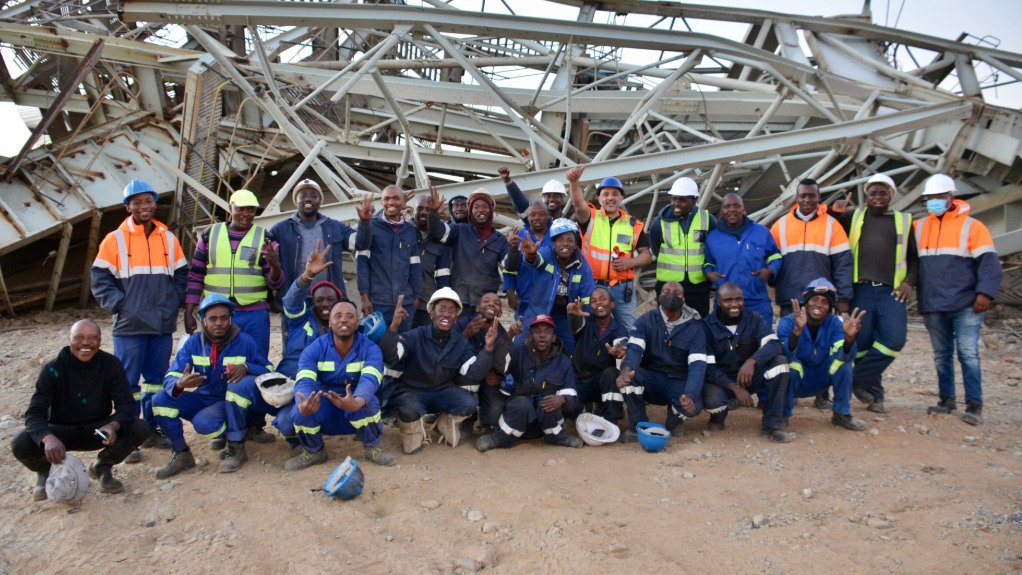
SAFETY FIRST The team involved at the decommissioning of the Beatrix 2 headgear reported a zero harm safety outcome after the project
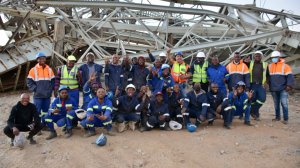


The demolition of diversified miner Sibanye-Stillwater’s 46-m-high headgear at the decommissioned Beatrix 2 shaft, which forms part of the Beatrix 2 Shaft rehabilitation project, was successfully undertaken by demolition engineering company Draco Group in 2022, and has led to better on-site water and drainage management while restoring the area to a safe and environmentally stable state, reports Draco Group director Teddy Habib.
Besides the water and drainage aspects, the buildings and foundations within the 80 000 m2 demarcated area were shaped, levelled and rehabilitated to blend with the environment, while all exposed openings – such as ventilation shafts – were capped or closed.
The contracted engineering scope of the project covered five main work packages including asbestos identification and certified removal, demolition of all surface buildings and ancillary infrastructure, demolition of the steel headgear, shaft backfilling and capping, and final environmental rehabilitation including earthworks, drainage remediation and site reinstatement.
The demolition scope also included single and multistorey buildings, warehouses, ventilation duct structures, conveyor systems, concrete water tanks, thickeners, hard stands, tarmac roads, and all associated foundations and footings.
“The project combined hazardous material removal, structural demolition, heavy plant operations, shaft closure and environmental restoration in one programme,” he adds.
He says that in safety terms, the project was completed without serious injury or a fatality, “which is a significant milestone given the nature of the work, which included asbestos abatement, heavy plant demolition, work at height and the controlled collapse of a 750 t steel structure”.
Asbestos-handling-related success was measured not only by the absence of incidents but also by compliance outcomes, with Habib noting the project was completed with disposal certificates, air monitoring records, medical surveillance documentation and other regulatory records in place.
“Success on the environmental aspect of the project was measured against the environmental management plan, which Draco Group successfully instituted,” he adds.
Breaking Down the Break Down
Habib notes that Draco Group reviewed several dismantling methods before selecting the controlled drop approach for the decommissioning of the headgear, many of which were ruled out owing to negative contributing factors including the close locality to ongoing mining operations, the timeline required and the actual removal of the headgear elements.
He says a headgear is not a single rigid mass, but instead a three-dimensional frame with multiple load paths and built in redundancy, which makes its response to progressive cutting more complex than can be achieved through a simple tipping over.
Importantly, residual internal components – such as the sheave wheels, rope anchorages, maintenance platforms, conduit runs and other shaft-related elements – contributed extra mass and affected how the structure would rotate and fall, adding even further complexity to the project, notes Habib.
“On this project, direction was critical because the structure had to fall outwards, away from live shafts and other operationally sensitive areas, and land in a controlled zone where it could be safely processed afterwards.”
In this regard, he says a controlled drop “works somewhat like felling a tree, where engineers study the structure’s geometry, weight distribution, base members, connection details and condition”.
Thereafter, a cutting sequence designed to weaken the structure on the intended fall side while still leaving enough capacity on the opposite side to act as a hinge was employed, explains Habib.
When the final “trigger cuts” are made, the structure rotates under its own weight and falls into a predefined zone, he says.
“The result was that the headgear fell into the intended zone without incident and could then be processed within the wider rehabilitation and shaft closure programme,” says Habib.
Treating Asbestos Carefully
The early asbestos-related work on the Beatrix 2 Shaft rehabilitation project was initially expected to be a short phase, says Habib; however, the survey, assessment and removal process took longer than first anticipated owing to the complexity of the site.
“There were multiple structures, each with different ages, construction materials and levels of deterioration.”
Therefore, he says, the team had to establish not only whether asbestos was present, but also its condition, which is an important distinction, as intact asbestos cement and damaged or friable asbestos require different handling procedures and control measures.
In addition, the asbestos removal portion of work did not end with the removal of the product, with the impacted area needing to first undergo inspection, air monitoring and formal clearance certification before further demolition works could continue.
While pre-contract surveys identified asbestos-containing materials in prefabricated asbestos cement panel buildings, fascia boards and ceiling linings, Habib says once physical work started, the quantity, spread and condition of the material proved greater and, in some areas, more degraded than first anticipated. This dynamic increased the removal effort and extended the certified removal process.
Habib says that projects like these involve the systematic dismantling and removal of structures that were built to last a long time. As such, demolition workers were exposed to tough conditions that were frequently hot, dusty, noisy and physically demanding, while a mandatory safety and regulatory regime require constant discipline and attentiveness.
The zero harm safety outcome is not the product of management systems alone, says Habib, concluding that “. . . Draco Group would like to acknowledge the 43 men and women who delivered the Beatrix 2 Shaft project through their work, commitment and presence on site every day”.
Article Enquiry
Email Article
Save Article
Feedback
To advertise email advertising@creamermedia.co.za or click here
Research Reports
Projects


Latest Multimedia

Latest News

Showroom

We at Hawk High Pressure Pumps specialise in industrial pumps and pumping systems. Our high pressure washing equipment is locally manufactured and...
VISIT SHOWROOM
Your global lifecycle technology & service partner for materials & minerals processing equipment for coal, iron ore, copper, manganese & other...
VISIT SHOWROOM
Press Office
Announcements
What's On
Subscribe to improve your user experience...
Option 1 (equivalent of R125 a month):
Receive a weekly copy of Creamer Media's Engineering News & Mining Weekly magazine
(print copy for those in South Africa and e-magazine for those outside of South Africa)
Receive daily email newsletters
Access to full search results
Access archive of magazine back copies
Access to Projects in Progress
Access to ONE Research Report of your choice in PDF format
Option 2 (equivalent of R375 a month):
All benefits from Option 1
PLUS
Access to Creamer Media's Research Channel Africa for ALL Research Reports, in PDF format, on various industrial and mining sectors
including Electricity; Water; Energy Transition; Hydrogen; Roads, Rail and Ports; Coal; Gold; Platinum; Battery Metals; etc.
Already a subscriber?
Forgotten your password?
Receive weekly copy of Creamer Media's Engineering News & Mining Weekly magazine (print copy for those in South Africa and e-magazine for those outside of South Africa)
➕
Recieve daily email newsletters
➕
Access to full search results
➕
Access archive of magazine back copies
➕
Access to Projects in Progress
➕
Access to ONE Research Report of your choice in PDF format
RESEARCH CHANNEL AFRICA
R4500 (equivalent of R375 a month)
SUBSCRIBEAll benefits from Option 1
➕
Access to Creamer Media's Research Channel Africa for ALL Research Reports on various industrial and mining sectors, in PDF format, including on:
Electricity
➕
Water
➕
Energy Transition
➕
Hydrogen
➕
Roads, Rail and Ports
➕
Coal
➕
Gold
➕
Platinum
➕
Battery Metals
➕
etc.
Receive all benefits from Option 1 or Option 2 delivered to numerous people at your company
➕
Multiple User names and Passwords for simultaneous log-ins
➕
Intranet integration access to all in your organisation